Private Dining NYC for Groups of 15 or More
A planner's guide to the headcount, roughly 15 to 30, where a normal reservation stops working and emailing a private-dining or events manager starts being the faster option.
A group of 15 to 30 sits in an awkward middle zone: too big for a walk-in table, often too small to trigger a restaurant’s full private-dining sales process on its own. The question isn’t whether the restaurant can seat that many people. It’s whether a standing reservation, made the normal way, will actually put them at one connected table with one check and one point of contact. Past a certain headcount, in most Manhattan rooms, it won’t.
The threshold, stated plainly: once a party passes roughly 12 to 15 guests, stop calling for “a big table” and start emailing the restaurant’s private-dining or events contact instead. Below that line, a phone call to push two or three tables together usually works. Above it, only a room set aside in advance, with its own server and its own printed capacity, will seat the group together.
Quick answer: the 15-to-30 decision, at a glance
- Under 12 guests: a large reservation through the normal booking channel is usually enough. A host can push tables together on the floor.
- 12 to 20 guests: the point where semi-private space starts mattering. Some restaurants have a nook or alcove sized for exactly this; most don’t, and a phone reservation stops being reliable.
- 20 to 30 guests: functionally a private-dining inquiry everywhere. This is above what a semi-private space in a working dining room can usually absorb without disrupting other guests.
- What to ask for either way: the room’s published seated capacity, whether it’s fully enclosed or semi-private, and any food-and-beverage minimum, before you describe your event in detail.
Why a standing reservation stops working around 15 guests
A restaurant’s floor plan is built around two- and four-tops. Combining tables for eight or ten is routine. Combining tables for eighteen usually means commandeering a section other guests would otherwise be seated in, which most floor managers won’t commit to over the phone weeks out. That’s the operational reason the threshold sits where it does: it’s not about whether the room is physically big enough, it’s about whether a phone reservation carries the authority to reserve that much floor space in advance.
Private-dining and events teams exist to make exactly that commitment. They can hold a room, quote a minimum, and confirm a headcount in writing. A hostess taking a dinner reservation generally cannot.
Private dining NYC for groups of 15 to 30: what four rooms actually publish
The rooms below were selected because each publishes a specific seated capacity for at least one of its event spaces, rather than leaving the number to an inquiry call. That published number is what lets a planner size a group against a room before ever picking up the phone. None is presented as the “best” choice; each fits a different point on the 12-to-40 range.
Novita — under 15 stays semi-private
Novita, on East 22nd Street between Park Avenue South and Lexington Avenue in Gramercy Park, publishes a private dining alcove that seats 12, as listed on novitanyc.com (checked September 2026). That number is a useful marker for the low end of this range: a group of 12 or fewer can often stay semi-private, at a normal table, inside a working dining room. A group of 15 already exceeds it.
Craft — built for exactly this range
Craft, at 43 East 19th Street near Union Square, is the clearest example of a restaurant that has priced this exact decision into its floor plan. Its private and semi-private dining page lists a group-dining option seated at 16, a semi-private space seated at 28, and a separate private dining room seated at 40 with standing capacity for 75 (checked September 2026). A party of 20 sits inside the semi-private tier; a party of 30 pushes toward the private room. Craft is the strongest fit here for a planner who wants to see the exact jump in room size that a 15-to-30 group causes.
Gramercy Tavern — a 20-seat ceiling, then a jump to 40
Gramercy Tavern, at 42 East 20th Street in the Flatiron district, publishes its Private Dining Room at 20 seated and a separate semi-private space, the Vault Room, at up to 40, with a full restaurant buyout listed at 120 seated, according to its private dining page (checked September 2026). A group of 20 fills the Private Dining Room exactly. A group of 25 or more has to move up to the Vault Room, which is built for a wider range and priced accordingly.
Union Square Cafe — a wide private tier above a small semi-private table
Union Square Cafe, at 101 East 19th Street on the southeast corner of 19th and Park Avenue South, publishes a semi-private table seated at 10 next to the main dining room, a private room (Park & Irving) seated at 40 or standing at 45, and a full restaurant option seated at 90 or a cocktail-style event for 150, per unionsquarecafe.com (checked September 2026). There is no published option between 10 and 40 here, which matters for planning: a group of 20 at Union Square Cafe is already in the same room, and paying the same minimum, as a group of 35.
Neighborhood and transit notes for this stretch of Manhattan
All four rooms sit within a few blocks of each other in Gramercy, Flatiron, and Union Square. Union Square Cafe and Craft are both a short walk from the Union Square station (4, 5, 6, L, N, Q, R, W), which makes either an easy meeting point for a group arriving from multiple directions. Gramercy Tavern and Novita are closer to the 23rd Street stations (N, R, W, 6), a few minutes further north. For a group this size, walking distance from a subway hub matters more than it does for a table of four: guests tend to arrive in clusters, and a room within a block or two of a major station absorbs a staggered arrival better than one requiring a second transfer.
What to put in your first email to an events manager
Once the group crosses into the 15-to-30 range, write to the events contact directly rather than the general reservation line. A first email that gets a useful answer back includes:
- The exact date and a backup date, plus preferred start time.
- A realistic headcount range, not a single fixed number.
- Whether you need a fully enclosed room or a semi-private space is acceptable.
- Whether the event includes a presentation, music, or anything requiring AV.
- Any known dietary restrictions in the group, raised up front rather than left for the final week.
Sending a range instead of a single number matters here specifically: at Craft or Gramercy Tavern, whether your group lands at 18 or 28 can put you in a different room entirely, at a different minimum. Naming the range lets the events manager tell you that upfront instead of after a deposit is signed.
For a deeper look at how a headcount that shifts between booking and event date affects the contract itself, see Your Headcount Will Change. Plan the Contract Around That., and for more rooms sorted by their published seated capacity, see Private dining near Union Square: published capacities.
The same size question comes up outside Gramercy and Union Square. A planner’s look at how booking rules change once a Gramercy table hits eight or more covers the smaller end of this same curve, and for milestone events specifically, how to book a large-group birthday dinner in NYC walks through a related version of this same threshold.
Frequently Asked Question
My group is exactly 15 people. Do I really need to go through an events manager, or can I just call?
Call first, but expect to be redirected. Fifteen sits at the edge of what a phone reservation can absorb, and most hosts will point you to the private-dining line once you say the number aloud. It depends on the floor plan: a restaurant with a semi-private nook sized for 12 to 16, like Novita’s alcove, may seat 15 as a normal reservation. One without that in-between space, like Union Square Cafe, will likely route you straight to an events inquiry. Emailing the events contact directly saves a round trip.
The bottom line
Fifteen is not a hard rule anywhere; it’s the point where the math of a normal floor plan stops working and a restaurant’s private-dining process starts being the faster path, not the more complicated one. Somewhere between 12 and 20 guests, depending on the room, a phone reservation turns into an events inquiry whether you initiate that or not. Sending the inquiry yourself, with a date range, a headcount range, and a clear statement of what kind of room you need, gets an answer faster than finding out the hard way that the hostess stand can’t hold your table.
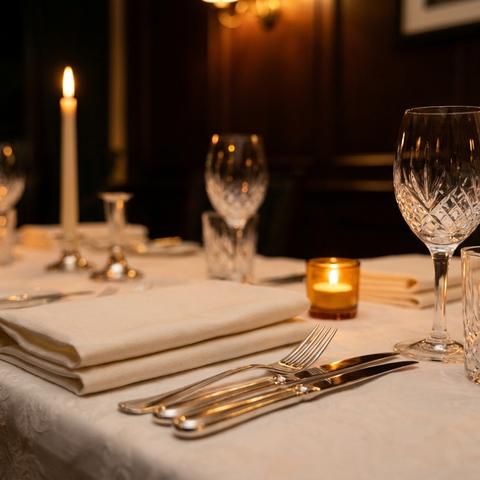
Hero image: The Four Seasons Restaurant - Private dining room by Mwatt510, via Wikimedia Commons (CC BY-SA 4.0).